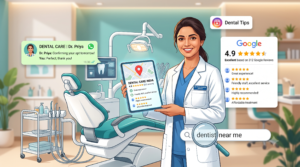
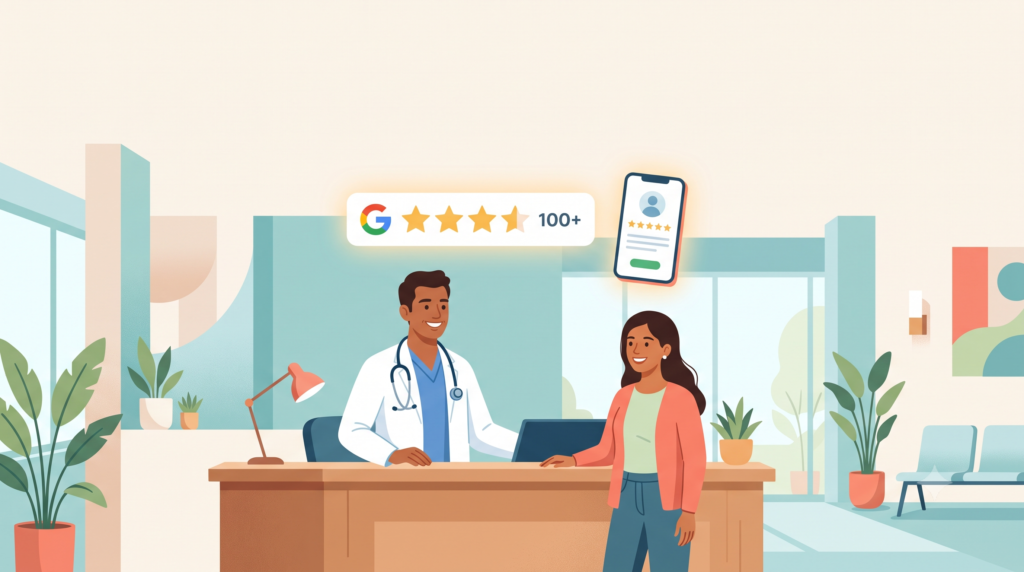
If you run a clinic in India, you already know the quiet truth of modern healthcare: patients Google you before they ever call you. They type your clinic name, glance at the star rating, skim three or four reviews, and decide in about eight seconds whether you’re worth a phone call. That little cluster of stars next to your name on Google Maps has quietly become your busiest receptionist.
So the goal of crossing 100+ Google reviews for your clinic is a worthy one. But here’s the part almost nobody tells you: in India, how you get those reviews matters as much as the number itself. Get it wrong and you can trip over the National Medical Commission’s conduct rules, or get a batch of reviews wiped out overnight by Google’s AI. Get it right and you build something no advertising budget can buy — a wall of genuine patient voices that keeps working for you every single day.
This is the honest, no-shortcuts guide to doing exactly that. No fake reviews. No cash-for-stars. No gimmicks that blow up in your face six months later. Just a real system that works for Indian clinics.
Why Google reviews decide who walks through your door
Let’s be clear about what’s actually at stake, because it’s bigger than vanity.
Google reviews do three jobs at once. First, they’re social proof — a nervous parent choosing a paediatrician trusts fifty strangers far more than they trust your website copy. Second, they’re a local ranking signal — Google’s local algorithm weighs review count, average rating, freshness, and keywords when it decides whose clinic shows up in the “Map Pack” (those top three listings with the map). More genuine reviews, arriving steadily, generally means better visibility for searches like “clinic near me” or “gynaecologist in Andheri”. Third, reviews are increasingly what AI search tools (Google’s AI Overviews, ChatGPT, Perplexity) read when a patient asks, “Who’s a good dentist in Jaipur?”
A clinic sitting at 12 reviews and 3.9 stars looks fragile. A clinic at 140 reviews and 4.7 stars looks established, safe, obviously the default choice. Same doctors, same treatment rooms — completely different first impression. That gap is worth a great deal in a country where a single new patient can be worth years of family referrals.
Start with the uncomfortable part: the ethics and the law
I’m putting this first on purpose, because if you skip it, everything else can backfire.
India regulates how doctors and clinics promote themselves far more tightly than most business owners realise. The National Medical Commission (NMC) notified a detailed conduct code — the Registered Medical Practitioner (Professional Conduct) Regulations, 2023 — that explicitly told doctors not to request or display patient testimonials, reviews, or endorsements, and not to buy likes, followers, or paid ratings, and not to solicit patients directly or indirectly. Those 2023 regulations were kept in abeyance (put on hold) soon after, so the currently enforceable code is the older 2002 Ethics Regulations. But — and this is the important bit — the 2002 code also prohibits a registered medical practitioner from soliciting patients directly or indirectly and from self-advertising. And the 2023 code tells you exactly where the regulator wants to go next.
So how does a clinic build up to 100+ reviews without crossing that line? By understanding two distinctions that most people miss.
Distinction one: the clinic as an establishment versus the individual doctor. Your clinic or hospital is a business entity, and it has a legitimate Google Business Profile — an address, hours, phone number, directions. Patients leaving honest feedback about their experience at the establishment is normal and expected, the same as for any local business. The tighter conduct rules apply most sharply to the individual registered practitioner self-promoting, soliciting, or turning patient gratitude into advertising material.
Distinction two: passively enabling honest feedback versus actively soliciting and staging it. There is a real difference between making it easy for any patient to share an honest experience if they choose to, and soliciting praise, scripting it, incentivising it, or republishing testimonials as marketing. The first is defensible and healthy. The second is where clinics get into trouble — both with the medical regulator and with Google.
The practical, prudent line I’d draw for any Indian clinic is this:
- Do keep an accurate, well-maintained Google Business Profile and make it effortless for patients to leave honest feedback if they wish.
- Don’t offer any incentive (discount, free consult, gift, points) for a review.
- Don’t filter who gets asked based on how happy they seem.
- Don’t script the review, or ask a patient to praise a specific doctor by name.
- Don’t lift patient reviews and republish them as promotional testimonials, before-and-after content, or “success stories” on your website and social media.
- Don’t buy reviews, or use agencies that manufacture them.
Everything in this guide stays on the right side of that line. (A quick caveat: this is practical guidance, not legal advice, and state medical councils sometimes add their own rules. If you run a larger hospital or a cosmetic/aesthetic practice, run your review process past your compliance advisor once. It’s a one-hour conversation that can save you a world of trouble.)
Change how you think about reviews
Here’s the mindset shift that separates clinics that struggle at 20 reviews from clinics that sail past 100.
You don’t get reviews. You earn them, and then you make them easy to leave.
Reviews are a lagging indicator of patient experience. A patient who waited 90 minutes past their appointment, felt rushed, and got a curt answer to their question is not going to leave you five stars no matter how nicely you ask. A patient who felt genuinely cared for — seen on time, listened to, explained things in plain language — is already willing to say something nice. Your job is simply to remove the friction between that goodwill and the review box.
So the real work is two-sided: fix the experience so the goodwill exists, then build a quiet, consistent, compliant system that lets that goodwill land on Google. Let’s build both.
The system that gets you to 100+ (step by step)
Step 1: Claim and fully optimise your Google Business Profile
You’d be surprised how many clinics are trying to collect reviews on a half-finished or unclaimed listing. Before you ask anyone for anything, get the foundation right.
Claim your Google Business Profile and verify ownership. Then fill in everything: the exact clinic name (no keyword-stuffing — “Sunrise Dental Clinic,” not “Sunrise Dental Clinic Best Dentist Koramangala”), the correct category (e.g., “Dental clinic,” “Pediatrician,” “Diagnostic center”), precise address with a correct map pin, accurate hours including holidays, phone number, and website. Add real photos of the reception, waiting area, and exterior — patients want to recognise the place when they arrive. A complete, accurate profile ranks better and converts better, which means the reviews you collect actually get seen.
Step 2: Fix the experience that produces reviews
This is the unglamorous step everyone wants to skip. Don’t.
Walk your own patient journey as if you were a first-timer. Was the appointment on time, or roughly so? Did the front desk greet people or ignore them? Did the doctor explain the diagnosis in language a scared patient could follow? Was billing transparent? Did anyone follow up? Each of those moments is a deposit or withdrawal in the goodwill account that reviews are eventually drawn from.
One paediatric clinic I worked with in a tier-2 city was stuck at a dismal rating for months. We didn’t touch their “ask.” We fixed one thing: they started sending a same-evening WhatsApp message from the doctor’s assistant — “How is [child’s name] feeling this evening? Reply here if the fever hasn’t settled.” Parents were floored. Reviews started appearing on their own, before anyone was even asked. Experience first, always.
Step 3: Ask everyone, at the right moment, in neutral language
Now the ask itself. Three rules keep it both effective and compliant.
Ask everyone equally. Do not pre-screen patients by how satisfied they seem and only invite the happy ones. That practice is called review gating, and Google explicitly prohibits it — its AI systems are now trained to detect the pattern where a clinic mysteriously only ever receives glowing reviews. Sending some patients to Google and unhappy ones to a private complaint form is exactly the kind of manipulation that gets an entire profile penalised. The compliant approach is simpler anyway: the same invitation goes to every patient.
Ask after the visit, never on the premises. Google’s 2026 policy update specifically calls out pressuring patients to review while they’re still standing at your counter, and bans review kiosks and shared tablets at reception. Beyond the policy, it’s just awkward — a patient filling in a review two feet from the receptionist will never be honest. Send the invitation after they’ve left: a text or WhatsApp a few hours later, or the next morning, works beautifully.
Use neutral wording. Don’t ask for a “5-star review” or a “positive review.” Ask for honest feedback. Something like: “Thank you for visiting [Clinic Name] today. If you have a moment, we’d value your honest feedback about your experience — it helps other patients and helps us improve. [Review link].” Notice what’s missing: no rating requested, no incentive, no mention of a specific doctor to praise.
Step 4: Remove every ounce of friction
The single biggest reason patients don’t leave reviews isn’t that they don’t want to — it’s that it’s mildly annoying. Fix that.
Create your clinic’s direct Google review link (Google now officially supports shareable review links) and shorten it. Turn that link into a QR code and place it thoughtfully — printed on the discharge summary, the prescription pad footer, the billing receipt, a small tented card handed over as the patient is leaving (not pressed on them at the desk). For the WhatsApp/SMS follow-up, the link should open the review box in one tap. Every extra step you remove roughly doubles your completion rate. A patient should be able to go from “sure, I’ll leave a review” to “done” in under 30 seconds.
Step 5: Turn your front desk into quiet ambassadors
Your reception and nursing staff are your review engine, but only if they’re trained and comfortable. The instruction is not “get me reviews.” It’s: “When a patient seems happy as they leave, it’s completely fine to mention, warmly and without pressure, that we welcome honest feedback on Google, and here’s the card.” Open-ended, optional, human. Staff should never demand it, never chase it, never ask a patient to write anything specific, and never enter reviews on a patient’s behalf.
One caution worth repeating: do not run staff review “targets” or competitions tied to how many patient reviews come in. Google now flags staff quota patterns, and it also nudges your team toward exactly the pushy behaviour you want to avoid.
Step 6: Respond to every review — especially the ones that sting
Responding to reviews does three things: it signals to Google that you’re an active, real business (which helps ranking), it shows prospective patients that you care, and it defuses the occasional bad review.
For positive reviews, a short, warm, human reply is plenty — but protect privacy fiercely. Never confirm someone was your patient, never mention their condition, treatment, or any clinical detail, even if they mentioned it. A safe reply: “Thank you so much for the kind words. We’re grateful for your trust and always here if you need us.” That’s it. Patient confidentiality doesn’t switch off just because the patient went public first.
For your review responses, keep them clean of promotional language, discount offers, or links to your services — Google flags those in replies now too.
Step 7: Be consistent, and let it compound
Here’s the quiet secret of clinics that cross 100+ reviews: they don’t do a big one-time push. In fact, a sudden burst of reviews — 60 in a week where you normally get two — is one of the fastest ways to get filtered by Google’s spam systems, which watch for unnatural volume spikes.
Instead, aim for a steady drip: a handful of genuine reviews every week, arriving naturally from a system that runs on its own. Ten a month is 120 a year. Twelve a week gets you past 100 in about two months. Consistency beats intensity every single time, and it looks natural to Google because it is natural.
What NOT to do — the landmines that wreck clinics
Some of these will be tempting. All of them are traps.
- Buying reviews. Fake reviews from review farms are the single fastest route to a suspended profile. Google removed hundreds of millions of policy-violating reviews in 2025 alone using its Gemini-powered detection, and it’s getting better every month. Bought reviews also violate the spirit of India’s medical conduct rules squarely. Never.
- Offering incentives. A discount, a free consultation, loyalty points, a lucky draw entry — any reward tied to leaving a review is prohibited by Google, regardless of whether you ask for a positive review or just an honest one. There is no “small gift” exception. It also reads as inducement under medical ethics norms.
- Review gating. Screening patients and only routing the happy ones to Google, as covered above. Prohibited and now actively enforced.
- On-premises kiosks or pressure. Tablets at reception, “please review us before you go” at the billing counter. Off-limits under the 2026 policy.
- Asking patients to name the doctor. Google’s 2026 update specifically bans asking customers to mention a staff member by name. For clinics this rule does double duty — naming and praising a specific doctor as promotional endorsement also brushes against the NMC’s stance on doctor self-promotion. Keep review requests about the clinic experience, not about glorifying an individual.
- Reviews from staff, family, or friends. These are a conflict of interest and Google removes them. A dozen five-star reviews that all trace back to your own team is worse than no reviews at all.
- Republishing reviews as marketing testimonials. Screenshotting glowing reviews and posting them as “patient success stories” on Instagram or your homepage is exactly the testimonial-as-advertising use the NMC 2023 code warned against. Let the reviews live where patients left them.
When a bad review lands (and one eventually will)
Every clinic gets a rough review sooner or later — often unfair, occasionally from someone who was never even a patient. How you handle it matters more than the review itself, because future patients are watching your response.
Take a breath before replying. Never get defensive, never argue clinical facts in public, and never disclose anything about the person. A calm, professional response works: “We’re sorry your experience didn’t meet expectations. We take all feedback seriously — please contact us directly at [number] so we can understand and make things right.” You’ve shown prospective patients that you’re reasonable and responsive, which quietly neutralises the sting of the complaint.
If a review is genuinely fake, defamatory, or clearly violates Google’s rules (spam, a competitor, hate speech, someone who was never a patient), flag it through your Google Business Profile dashboard with the appropriate violation reason, document it with screenshots, and be patient — Google’s review process takes time but does act on clear violations. What you should not do is offer the reviewer anything to take it down; offering an incentive to remove a negative review is itself a policy violation.
A realistic 90-day roadmap to 100+ reviews
Here’s how this looks in practice, assuming you’re starting from a low base.
Weeks 1–2 — Foundation. Claim and fully optimise the Google Business Profile. Generate your direct review link, shorten it, and create the QR code. Print it onto discharge summaries, receipts, and a small take-home card. Draft your neutral, template WhatsApp/SMS follow-up message.
Weeks 3–4 — Fix and train. Walk your patient journey and fix the one or two friction points that are costing you goodwill. Train front-desk and nursing staff on the warm, no-pressure, no-quota approach. Do a small test run with the follow-up message.
Weeks 5–12 — Run the steady drip. Send the honest-feedback follow-up to every patient after their visit. Respond to every review within a day or two, keeping replies private-safe and promo-free. Watch the pace stay natural — if you’re a smaller clinic getting five to fifteen genuine reviews a week, you’ll cross 100 comfortably within the quarter without a single spike that looks suspicious.
The clinics that hit this target aren’t the ones with the cleverest campaign. They’re the ones with a boring, reliable system that asks every patient, at the right time, in neutral language, and then gets out of the way.
Measure what actually matters
Chasing the raw number alone is a mistake. Watch these instead: your average rating (protect it — a wall of fours and fives is more persuasive than a bigger pile with a mediocre average), your review velocity (a steady weekly trickle, not spikes), your response rate (aim for 100% — reply to every single one), and your Map Pack visibility for your core searches. When those four move together, the patient calls follow.
Frequently asked questions
Is it legal for a clinic in India to ask patients for Google reviews?
A clinic maintaining an accurate Google Business Profile and making it easy for patients to leave honest feedback is broadly acceptable, but the medical conduct rules are strict about soliciting patients and using testimonials as advertising. The safe path is to enable honest feedback passively and neutrally — never incentivise it, never script it, never republish reviews as promotional material, and don’t build campaigns around an individual doctor’s self-promotion. When in doubt, check with your compliance advisor.
Can I offer a discount or free consultation for a Google review?
No. Any incentive tied to a review — cash, discount, gift, points, lucky draw — is prohibited by Google regardless of whether you ask for a positive or merely honest review, and it also reads as inducement under medical ethics norms. Google can and does remove incentivised reviews and penalise the profile.
How many Google reviews does a clinic actually need?
There’s no magic number, but crossing 50 gives you credibility and 100+ makes you look like the established default in your area. Average rating and freshness matter as much as volume — a clinic at 100 reviews and 4.7 stars, with new ones arriving weekly, beats one at 300 stale reviews and 3.8 stars.
Why did some of my clinic’s reviews disappear?
Usually one of three reasons: a sudden unnatural spike in volume (which trips spam filters), reviews from accounts linked to your staff or family, or reviews that were incentivised or gated. Google’s automated systems remove these. Rebuild slowly and organically rather than trying to quickly replace them, which only triggers more filtering.
How long does it take to reach 100 reviews?
With a consistent, frictionless follow-up system, a moderately busy clinic can reach 100+ in two to four months. The pace should feel steady, not explosive — natural growth both satisfies Google and reflects real patient goodwill.
Should I ask patients to mention the doctor’s name or the treatment in their review?
No. Google’s 2026 policy bans asking patients to name specific staff, and for clinics, steering reviews toward praising an individual doctor also brushes against India’s rules on doctor self-promotion. Keep the invitation about the overall clinic experience and let patients say whatever they honestly wish.
The bottom line
Getting your clinic past 100+ Google reviews in India isn’t about a clever hack. It’s about earning genuine goodwill through a good patient experience, then building a quiet, consistent, compliant system that lets that goodwill reach Google without you ever begging, buying, bribing, or bending the rules. Do it this way and you get something far more valuable than a number: a durable reputation that keeps filling your appointment book long after any advertising campaign would have run dry.
If you’d like help setting up a review system that grows your clinic’s reputation while staying fully on the right side of both Google’s policies and India’s medical conduct rules, that’s exactly the kind of work we do at Doctors Branding. Build it right once, and it works for you for years.