Why “Doctor SEO India” Isn’t Optional Anymore
A few years ago, a good reputation and a signboard outside your clinic were enough. A patient in Kolkata or Coimbatore would ask a neighbor, walk in, and that was that.
That world is gone.
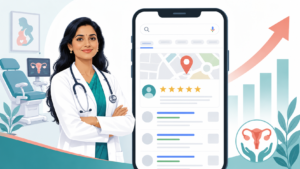
Today, the first “referral” most patients get is Google. Someone wakes up with chest tightness, ear pain, or a rash on their child’s arm, and their thumb goes straight to the search bar — not the phone book, not a friend’s WhatsApp group. They type “cardiologist near me” or “best skin doctor in Pune,” and whichever three clinics show up in that little map box at the top of the results are the ones who get the phone call.
If your clinic isn’t one of those three, you are, for all practical purposes, invisible to a huge share of the patients actively looking for you right now.
This guide is written specifically for Indian doctors, dentists, and clinic owners — not global agencies talking about American hospital chains. We’ll walk through exactly how Google decides who to show, what you personally need to do this month, and how to build a system that keeps bringing patients month after month without you having to think about it every day.
Grab a cup of chai. This is a long one, but by the end you’ll have a complete roadmap.
1. How Patients in India Actually Search for Doctors
Before touching a single setting, it helps to understand the searcher on the other end of the screen.
Most patients researching healthcare in India start their journey on a search engine before they ever pick up the phone, and a large majority of that searching happens on a mobile device, often while sitting in an auto-rickshaw or waiting at home. Their queries usually fall into three buckets:
- “Near me” searches — “dentist near me,” “ENT doctor near me.” These are high-intent, ready-to-book patients.
- Specialty + city searches — “best gynaecologist in Indore,” “paediatrician in Andheri West.” These patients are comparing 2–3 options.
- Symptom-first searches — “why does my knee hurt when climbing stairs.” These patients haven’t decided who to see yet; this is where blog content earns you a future patient.
There’s also a growing wave of voice search happening in Hindi and regional languages — someone speaking into their phone asking, in Marathi or Tamil, for a doctor nearby. If your online presence only exists in English, you’re quietly losing this segment.
The practical takeaway: your SEO strategy needs three legs — a strong local presence (for “near me” searches), a well-optimised website (for comparison searches), and useful content (for symptom-first searches that convert into patients over time).
2. Google Business Profile: Your Single Most Important SEO Asset
If you do only one thing after reading this article, do this.
Your Google Business Profile (GBP) — the free listing that shows your clinic on Google Maps and in the local map pack — is now the single biggest lever for patient acquisition for individual doctors and small clinics. It typically outperforms your website in influence because Google trusts it more, updates it faster, and shows it first.
Get the basics airtight
- Claim and verify your profile if you haven’t already (video verification is now common and usually the fastest route).
- Business name: Use your real clinic name only. Don’t stuff it with keywords like “Dr. Sharma Best Dentist Andheri” — Google penalises this, and it can get your listing suspended.
- NAP consistency: Your Name, Address, and Phone number must be identical, character for character, everywhere — your website, Practo, Justdial, Facebook, your prescription pad, everywhere. Even a “Rd.” vs “Road” mismatch chips away at Google’s confidence in your listing.
- Category selection: Choose the most specific primary category available (e.g., “Dermatologist” rather than the generic “Doctor” or “Medical Clinic”). This single setting determines which searches you’re even eligible to appear for.
- Service area and address: Be precise about the neighbourhood, not just the city — Google increasingly matches listings to hyper-local searches like “physiotherapist near Koramangala 5th Block.”
Keep it active, not just complete
A profile you fill out once and abandon will slowly lose visibility. Google now treats an active, regularly updated profile as a genuine trust signal, similar to how it treats an active social media account.
- Add 2–3 fresh photos a week — your clinic exterior, waiting area, your team at work (real photos, never stock images).
- List every individual service separately with a short description (e.g., “Root Canal Treatment,” “Teeth Whitening,” “Braces & Aligners”) rather than one vague line — this is literally the data Google matches against specific searches.
- Post short updates weekly — a new service, an extended Saturday clinic, a health awareness tip. These posts also feed the AI systems (like Gemini) that now summarise your business in search results.
- Respond to every review, positive or negative, within 48 hours.
Why this matters more for doctors specifically
Healthcare is treated by Google as a YMYL category — “Your Money or Your Life.” That means Google applies a higher trust bar to medical listings and content than it does to, say, a restaurant. A complete, consistent, active profile is one of the clearest ways you signal legitimacy to that stricter algorithm.
3. On-Page SEO for Your Clinic Website
Your website is where comparison-shopping patients go to decide you’re the right choice, and it’s what Google reads to understand your expertise beyond the map listing.
Title tags and meta descriptions
Every page — homepage, each service page, each doctor’s bio — needs its own unique title tag and meta description.
- Title tag formula:
[Service/Specialty] in [City] | [Clinic Name]— for example, “Best Orthodontist in Jaipur for Braces & Aligners | Smile Dental Care.” Keep it under 60 characters so Google doesn’t truncate it. - Meta description: 150–160 characters, written like a small ad. Mention the service, the location, and a reason to click — “Book a consultation with Jaipur’s experienced orthodontist. Same-day appointments, 15+ years experience, 500+ 5-star reviews.”
Headings and page structure
- One H1 per page that clearly states what the page is about and includes your primary keyword naturally (e.g., “Cardiologist in Chennai — Dr. Ravi Kumar”).
- Use H2s to break the page into scannable sections: symptoms treated, procedures offered, what to expect during a visit, doctor’s credentials.
- Write short paragraphs. Patients skim on mobile; walls of text lose them fast.
Location-specific service pages
Instead of one generic “Services” page, create individual pages for each major service, and if you serve multiple areas, individual pages for each — “Physiotherapy in Whitefield,” “Physiotherapy in Indiranagar.” Each becomes its own doorway into your site from a very specific search.
Doctor bio pages that build trust
Every practitioner should have a dedicated page listing their MBBS/MD/MS credentials, registration number, years of experience, specialisations, and a genuine photograph. This isn’t just good practice — it’s exactly the kind of “Experience and Expertise” signal Google’s quality guidelines look for on medical sites.
URLs
Keep them short, lowercase, hyphenated, and readable: /services/root-canal-treatment-mumbai/ rather than a string of random characters or ID numbers.
4. Local Citations and Directory Listings (Practo, Justdial, Lybrate)
Directory platforms aren’t your competition — they’re free citation-building and trust-building opportunities, as long as your information matches your website and GBP exactly.
Priority directories for Indian doctors:
- Practo
- Justdial
- Lybrate
- Sulekha
- IndiaMart (for clinics offering equipment/diagnostics too)
- Local city-specific directories and hospital association listings
- Your state medical council directory, if publicly listed
On each, keep your NAP identical, list your specialisations completely, upload real photos, and — critically — encourage patients to leave reviews there too, not only on Google. A scattered but consistent presence across these platforms tells Google your clinic is an established, real-world entity, which directly supports your Maps ranking.
5. Content Strategy: What to Actually Write About
This is where most clinics either waste time on generic “5 tips for healthy teeth” posts, or skip content entirely because they assume it doesn’t matter for a local business. Both are mistakes.
Content works for you in three ways: it captures symptom-first searchers before they’ve chosen a doctor, it builds the topical depth Google associates with genuine expertise, and it gives AI tools like Google’s AI Overviews and ChatGPT something concrete to cite when summarising an answer.
What actually converts for a clinic blog
- Symptom and condition guides: “Why Does My Lower Back Hurt When I Sit Too Long?” — written to eventually and naturally lead the reader to book a consultation.
- Procedure explainers: “What to Expect During a Root Canal” — reduces patient anxiety and pre-sells the visit.
- “Best doctor for X in [city]” style comparison content written honestly about how to choose a provider (yes, even mentioning what to look for beyond just your own clinic) — this builds trust and performs well because it matches real search intent.
- FAQ-style posts answering the exact questions patients type into Google.
Write for a real answer, not just a keyword
Structure your key answers as tight, direct paragraphs of roughly 40–60 words near the top of the section, followed by more detail underneath. This format is exactly what both Google’s AI Overviews and AI chat tools pull from when generating a summarised answer — get this right and you can appear as a cited source even when the patient never clicks through.
Keep everything medically accurate and dated
Add a “medically reviewed by” line with the reviewing doctor’s name and registration details, and show a last-updated date. In a YMYL niche, this single detail does more for your credibility, in Google’s eyes, than almost any design choice.
6. Reviews and Reputation: The Trust Engine
Reviews are no longer a “nice to have” — recent industry research consistently shows the overwhelming majority of patients read reviews before booking, and most of that reading happens directly on Google.
How to build a genuine review engine:
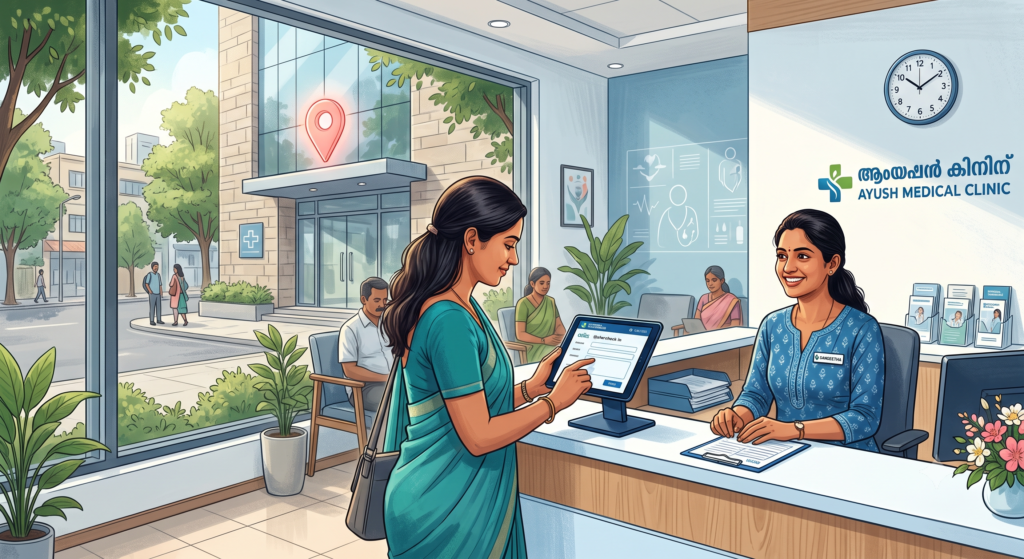
- Ask in person, right after a positive interaction — a simple QR code at the reception desk pointing straight to your Google review link removes almost all friction.
- Never buy reviews or run review-gating schemes (asking happy patients to review publicly while diverting unhappy ones elsewhere) — Google actively detects and penalises this, and it’s an ethical problem in healthcare specifically.
- Encourage detail-rich reviews. A review that says “Dr. Mehta explained my thyroid results clearly and the wait was under 10 minutes” helps far more — for both patients and Google’s understanding of your services — than a bare five stars.
- Respond to negative reviews calmly and professionally, without disclosing any patient health information. A thoughtful public response often reassures future patients more than the negative review hurts you.
7. Schema Markup for Doctors (The Technical Bit, Explained Simply)
Schema markup is invisible code that tells search engines exactly what your content is, rather than making them guess. Think of it as labelling your website in a language machines understand perfectly.
For a clinic, the important schema types are:
- MedicalOrganization / LocalBusiness schema — clinic name, address, phone, hours, specialties.
- Physician schema — for each doctor’s individual bio page: name, credentials, specialisation.
- FAQPage schema — wraps around your FAQ sections so Google can potentially display them as expandable rich results directly in search.
You don’t need to hand-code this. Most WordPress clinic sites can add it through a plugin like Rank Math or Yoast, or your developer can add it directly. The effort is small; the payoff — better rich results and cleaner data for AI systems summarising your practice — is significant.
8. Optimising for AI Search — ChatGPT, Gemini, and Google AI Overviews
A meaningful and growing share of healthcare-related searches in 2026 now end without a click, because the searcher gets their answer directly from an AI-generated summary at the top of the page, or from a chatbot conversation entirely outside Google. This is often called Generative Engine Optimisation (GEO), and for doctors it’s becoming just as important as traditional SEO.
How to show up inside AI answers:
- Write clear, factual, well-structured content with genuine author credentials attached.
- Use schema markup so AI systems can extract clean, verified facts about your practice rather than guessing.
- Keep your Google Business Profile active — Gemini increasingly pulls directly from your GBP photos and posts when describing your business in AI answers.
- Get mentioned and linked from other credible health sites — AI models weigh outside authority heavily, much like traditional search does.
- Keep content current. AI systems favour freshly updated pages over stale ones when choosing what to cite.
Even if the patient never clicks your website, being the source an AI tool cites by name when someone asks “who’s a good dermatologist in Lucknow” is real brand visibility you can’t get any other way.
9. Technical SEO and Mobile Speed
Most of your patients are on a phone, often on an average mobile connection, possibly standing in a hospital corridor with patchy signal. If your site takes more than 3 seconds to load, a large share of visitors leave before they even see your services.
Quick technical checklist:
- Compress every image before upload (tools like TinyPNG or converting to WebP format work well).
- Make sure your site is genuinely mobile-responsive, not just “technically works” on a phone.
- Use HTTPS (a padlock icon) — non-negotiable for a healthcare site handling any patient data.
- Submit an XML sitemap through Google Search Console so Google can find and index every page.
- Fix broken links and outdated appointment forms — nothing kills trust faster than a “Book Now” button that doesn’t work.
10. Building Authority With Backlinks (The Right Way)
A backlink is simply another website linking to yours — Google treats it as a vote of confidence, and in a trust-sensitive field like healthcare, where those votes come from matters enormously.
Legitimate ways doctors earn backlinks in India:
- Get listed and linked from your hospital’s website, medical association, or alumni network.
- Contribute a genuinely useful guest article to a reputable local health blog or news outlet.
- Sponsor or participate in local health camps and community events that get local press coverage.
- Get quoted by local journalists — many city publications actively look for doctors willing to comment on health trends; a quick outreach email can open this door.
Avoid any service promising “500 backlinks for ₹999.” These come from spammy, low-quality sites and can actively damage a healthcare site’s standing with Google.
11. Common Mistakes Indian Clinics Make
- Treating the website as a one-time project. SEO is ongoing maintenance, not a launch-and-forget task.
- Inconsistent NAP details across the website, GBP, and directories — this alone can silently cap your local rankings.
- Buying cheap, automated “SEO packages” that use spammy tactics — in a YMYL niche, these get penalised harder and faster than in almost any other industry.
- Ignoring reviews — both not asking for them, and not responding when they come in.
- Writing generic content that could apply to any clinic in any city, instead of content that’s specific to your practice, your doctors, and your patients’ real questions.
- No mobile optimisation — for a patient base that’s overwhelmingly searching from a phone, this is close to fatal.
12. Your 90-Day Doctor SEO Action Plan
Days 1–15: Foundation
- Fully complete and verify your Google Business Profile.
- Audit and correct NAP consistency across your website, GBP, and every directory listing.
- Set up Google Search Console and Google Analytics.
Days 16–45: On-Page and Local
- Rewrite title tags and meta descriptions for every page.
- Build or refresh individual service pages.
- Claim and complete profiles on Practo, Justdial, and Lybrate.
- Add schema markup (MedicalOrganization, Physician, FAQPage).
Days 46–75: Content and Reviews
- Publish 4–6 well-researched blog posts targeting symptom and procedure searches.
- Launch an in-clinic review-request system (QR code at reception).
- Start weekly Google Business Profile posts and photo uploads.
Days 76–90: Authority and Review
- Reach out for 3–5 legitimate local backlink opportunities (hospital pages, local press, associations).
- Review Search Console data — fix crawl errors, check which pages are gaining impressions.
- Set next quarter’s content calendar based on what’s actually working.
13. Frequently Asked Questions
How long does doctor SEO take to show results in India?
Your Google Business Profile can start appearing in local search within a few weeks of verification. Organic website rankings for competitive specialties usually take three to six months of consistent work to gain meaningful traction.
Is Practo enough, or do I really need my own website?
Practo gives you fast discoverability, but you have no control over the design, the conversion path, or your own patient data on someone else’s platform. A dedicated website paired with an active GBP consistently outperforms relying on directory listings alone.
How much should a clinic budget for SEO in India?
This varies widely by city and competition, but a serious, sustainable local SEO effort for a single-location practice typically starts in the mid four figures per month in rupees and scales up in metro markets with heavy competition. Be cautious of anything priced far below market rate — it’s almost always a sign of automated, black-hat tactics that put a healthcare listing at real risk.
Do I need a website in regional languages?
If a meaningful share of your patients search in Hindi or another regional language, yes — even a well-optimised regional-language landing page for your top service can capture a segment of searchers your English-only competitors are missing entirely.
What’s the single highest-ROI thing I can do this week?
Completely fill out your Google Business Profile — every service, every photo, every detail — and start asking every satisfied patient for a Google review. It’s free, and for most individual doctors and small clinics it’s the fastest lever to pull.
Conclusion
Ranking your clinic on Google isn’t about chasing algorithm tricks — it’s about becoming genuinely easy to find, easy to trust, and easy to choose for a patient who’s often anxious, in pain, or searching on behalf of someone they love. Google Business Profile, honest reviews, a fast and clear website, and content that actually answers real questions will consistently outperform shortcuts, especially in a trust-sensitive field like healthcare.
Start with your Google Business Profile this week. Everything else in this guide builds on that foundation.
If you’d rather have this entire system built and managed for you, the team at DoctorsBranding.Online works exclusively with Indian doctors and clinics on exactly this — Google Business Profile management, website SEO, and content, done right for a YMYL niche. [Get in touch for a free clinic visibility audit.]