
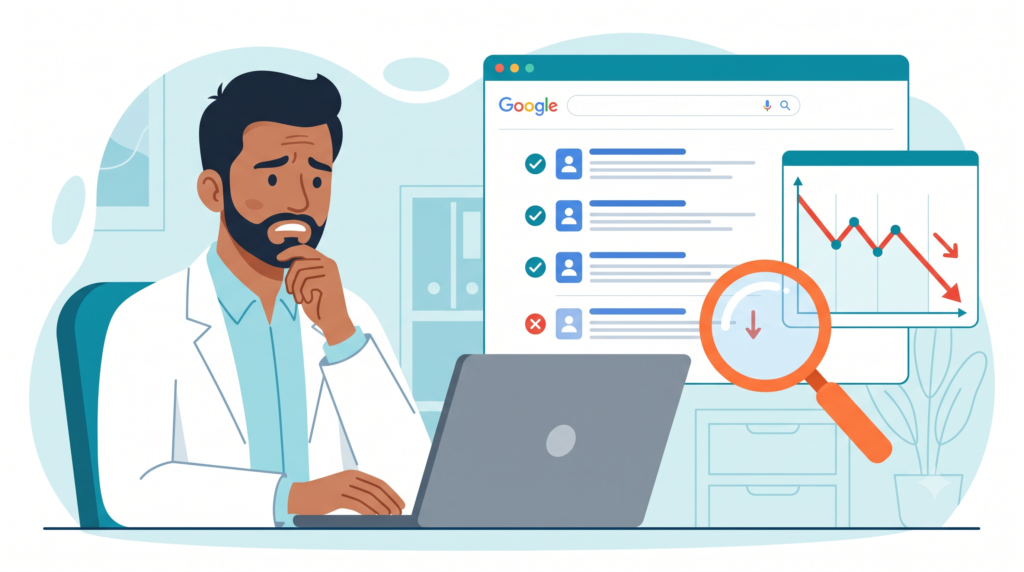
You built a website for your practice. It looks decent, it has your address, your specialties, maybe even a few photos of the clinic. And yet, when a patient in your own city searches for a doctor like you, your website is nowhere on the first page. Sometimes it’s not even on the third.
If that stings, you’re not alone. A doctor website not ranking on Google is one of the most common problems we see at Doctors Branding — and here’s the honest truth most agencies won’t tell you: it’s almost never one big mistake. It’s usually five or six small ones stacked on top of each other.
The good news? Every one of them is fixable. In this guide, I’ll walk you through exactly why your medical website is invisible on Google, and what to do about it — step by step, in plain language, no jargon dumps.
Let’s diagnose this properly. (You’d expect nothing less from a healthcare blog, right?)
First, Understand How Google Sees a Doctor’s Website
Before we get into the fixes, you need to know one thing: Google treats medical websites differently from almost every other kind of website.
Health content falls under what Google calls YMYL — “Your Money or Your Life” pages. These are pages that can affect someone’s health, safety, or finances. Google holds them to a much higher standard because bad medical information can genuinely hurt people.
That means for a doctor’s website, Google is constantly asking:
- Is this site written or reviewed by a real, qualified medical professional?
- Does it demonstrate E-E-A-T — Experience, Expertise, Authoritativeness, and Trustworthiness?
- Is it technically sound, fast, and secure?
- Do local signals (address, reviews, listings) confirm this is a real practice?
If your website doesn’t clearly answer “yes” to all four, Google quietly pushes it down and shows patients someone else — usually Practo, Justdial, hospital chains, or that competitor two streets away who invested in SEO early.
Now let’s look at the specific reasons your site is stuck, starting with the most common.
Reason #1: Your Website Was Built to Look Good, Not to Rank
This is the number one issue with doctor websites, and it’s rarely the doctor’s fault.
Most medical websites are built by general web designers. They deliver something visually clean — a hero image, a “Welcome to our clinic” headline, a contact form — and call it done. But from Google’s point of view, that website says almost nothing.
Here’s what typically goes wrong:
- The homepage headline says “Welcome to XYZ Clinic” instead of something Google can actually rank, like “Cardiologist in Durgapur — Dr. Sharma, XYZ Heart Clinic.”
- There’s one page for all services. Google can’t rank a single “Our Services” page for diabetes care, thyroid treatment, and heart checkups all at once. Each core service needs its own dedicated page.
- The site has 5–6 pages total. Thin websites struggle in healthcare, where Google rewards depth and topical authority.
How to fix it
- Rewrite your homepage title and H1 to include your specialty + your city. This alone can move the needle within weeks.
- Create a separate, detailed page for every major service you offer — what the condition is, symptoms, your treatment approach, FAQs, and how to book.
- Add proper doctor profile pages with qualifications, registration number, experience, and a real photo. This feeds directly into Google’s trust signals.
Think of your website like a hospital building: if everything is crammed into one room, nobody — including Google — can find the department they need.
Reason #2: You’re Ignoring Local SEO (The Biggest Missed Opportunity)
Here’s something that surprises many doctors: most of your future patients aren’t searching for you by name. They’re searching things like:
- “skin doctor near me”
- “best gynecologist in [city]”
- “child specialist open now”
These are local searches, and Google answers them with the “Map Pack” — those three business listings with stars and a map at the top of the results. If your practice isn’t in that box, you’re losing patients before your website even gets a chance.
How to fix it
1. Claim and fully complete your Google Business Profile. This is free and non-negotiable. Add your exact category (e.g., “Dermatologist,” not just “Doctor”), consultation hours, photos of the clinic, services, and a description that mentions your city and specialty.
2. Get consistent NAP citations. NAP means Name, Address, Phone number. It must be identical everywhere — your website, Google, Practo, Justdial, Lybrate, Facebook. Even small mismatches (“Road” vs “Rd.”) confuse Google and dilute your local authority.
3. Actively collect Google reviews. Reviews are one of the strongest local ranking factors. Ask happy patients — a simple QR code at the reception desk works wonders. Reply to every review, positive or negative, professionally. Google notices engagement.
4. Embed a Google Map and mention your locality naturally on your site. Your contact page should include your full address, an embedded map, landmarks, and nearby areas you serve.
A well-optimized Google Business Profile often starts bringing calls before your website rankings even improve. It’s the fastest win on this entire list.
Reason #3: Your Content Doesn’t Answer What Patients Actually Search
Patients don’t search “comprehensive endocrinology consultation.” They search:
- “why am I always tired and gaining weight”
- “is chest pain after eating serious”
- “PCOS treatment without surgery”
If your website only describes your services in clinical language, you’re invisible for the searches that actually happen. Meanwhile, health portals and content-heavy competitors capture those patients at the moment they’re worried — which is exactly when they’re deciding which doctor to visit.
How to fix it
Start a simple, honest blog. You don’t need to publish daily. Two to four well-written articles a month, each answering one real patient question, will outperform a silent website every time. For example:
- A pediatrician might write: “When Should You Worry About Your Child’s Fever?”
- An orthopedic surgeon: “Knee Pain While Climbing Stairs: Causes and When to See a Doctor”
- A dentist: “Root Canal vs Tooth Extraction: Which Is Right for You?”
Three rules for medical content that ranks:
- Write it (or review it) yourself, and say so. A line like “Medically reviewed by Dr. [Name], MD” with a linked author profile is a powerful E-E-A-T signal.
- Answer the question in the first two paragraphs, then go deeper. Google increasingly pulls direct answers into featured snippets and AI Overviews.
- End every article with a local call to action — “If you’re experiencing these symptoms, book a consultation at our [city] clinic.”
Each article becomes another doorway into your practice. Over a year, that’s dozens of doorways your competitors don’t have.
Reason #4: Technical Problems Are Quietly Killing Your Rankings
Sometimes the content is fine, the local listings are fine — and the website itself is the problem. Technical SEO issues are invisible to you but glaring to Google. The usual suspects:
Slow loading speed. Doctor websites are notorious for huge, uncompressed clinic photos. If your site takes more than 3 seconds to load on a phone, a large share of visitors leave — and Google tracks that. Test yours free at Google PageSpeed Insights.
Not mobile-friendly. Over 70% of health searches happen on mobile. If patients have to pinch and zoom to read your services or find your phone number, both they and Google will move on.
No HTTPS. If your site still shows “Not Secure” in the browser, that’s an immediate trust killer for a medical website. An SSL certificate is cheap (often free) and takes an hour to set up.
Pages Google can’t find. No XML sitemap, broken links, or accidental “noindex” tags mean Google may not even know your pages exist. Set up Google Search Console — it’s free and will tell you exactly which pages are indexed and which have errors.
Missing schema markup. Schema is code that tells Google explicitly: “This is a medical clinic, this is the doctor, these are the hours, this is the specialty.” Adding Physician and MedicalClinic schema (plus FAQ schema on blog posts) helps you earn richer search results.
How to fix it
Run your site through PageSpeed Insights and Search Console this week. Compress every image, get an SSL certificate if you don’t have one, and ask your developer to add local business and physician schema. Most of these are one-time fixes with long-term payoff.
Reason #5: Zero Authority — Nobody Is Vouching for You Online
In SEO, backlinks (other websites linking to yours) work like professional references. When reputable sites link to you, Google reads it as a vote of confidence. Most doctor websites have almost none — while hospital chains and health portals have thousands. That authority gap is a big part of why they outrank you even for searches in your own neighborhood.
How to fix it (without anything shady)
- Get listed on legitimate medical directories — Practo, Lybrate, your state medical council listings, hospital affiliation pages, and your medical association’s directory.
- Contribute your expertise. Local news outlets and health publications regularly need doctor quotes. One quoted article can earn you a strong, relevant backlink.
- Partner locally. Gyms, schools, pharmacies, and community organizations you already work with can link to your health camp announcements or awareness articles.
- Never buy cheap bulk backlinks. In the medical niche, spammy links can trigger penalties that are far harder to cure than prevention. (Sound familiar?)
Authority builds slowly, but it compounds. Ten genuine, relevant links will beat five hundred junk ones every single time.
Reason #6: You Expected Results Too Fast — or Gave Up Too Early
One more honest point, because it matters: SEO for doctors typically takes 3 to 6 months to show meaningful movement, sometimes longer in competitive cities. Many practices redesign their website, wait six weeks, see nothing, and conclude “SEO doesn’t work for doctors.”
It does work — it’s just cumulative. Rankings behave less like a light switch and more like physiotherapy: consistent sessions, gradual strengthening, lasting results.
Your 30-Day Action Plan (Start Here)
If everything above feels overwhelming, don’t try to do it all at once. Here’s the priority order I’d give any practice:
Week 1 — Foundations
- Claim/complete your Google Business Profile
- Install SSL (HTTPS) if missing
- Set up Google Search Console and submit your sitemap
Week 2 — On-Page Basics
- Rewrite homepage title tag and H1 with specialty + city
- Fix or add page titles and meta descriptions on every page
- Compress oversized images
Week 3 — Content Structure
- Create individual pages for your top 3 services
- Build a proper doctor profile page with credentials
Week 4 — Trust & Momentum
- Start collecting Google reviews (set up a QR code)
- Publish your first patient-question blog post
- Fix your NAP details across all directories
Do just this much, and you’ll be ahead of the majority of doctor websites in your city.
Frequently Asked Questions
How long does it take for a doctor’s website to rank on Google? Typically 3–6 months for local keywords with consistent effort. Google Business Profile improvements can bring visibility much sooner — sometimes within weeks.
Can I do SEO for my clinic website myself? The basics, yes — Google Business Profile, reviews, and blogging are very doable. Technical fixes and content strategy at scale usually benefit from professional help.
Is paid advertising better than SEO for doctors? They serve different purposes. Google Ads brings patients immediately but stops the moment you stop paying. SEO builds a durable asset that keeps working. The strongest practices use both — ads for the short term, SEO for the long term.
Why does my competitor rank above me even though I’m more experienced? Google can’t see your clinical experience — it can only see what your website, listings, reviews, and content communicate. Rankings reflect online signals, not medical skill. That’s fixable.
Final Word: Your Website Should Work as Hard as You Do
You didn’t spend years in medical school to be invisible to the patients searching for exactly what you do. A doctor website not ranking on Google isn’t a mystery — it’s a checklist. Weak local presence, thin content, technical gaps, and missing trust signals. Fix them methodically, and the rankings follow.
And if you’d rather focus on patients while someone else handles the SEO prescription, that’s precisely what we do at Doctors Branding — helping doctors and clinics build websites that don’t just look professional, but actually get found.
Your next patient is searching right now. Make sure they find you.
