
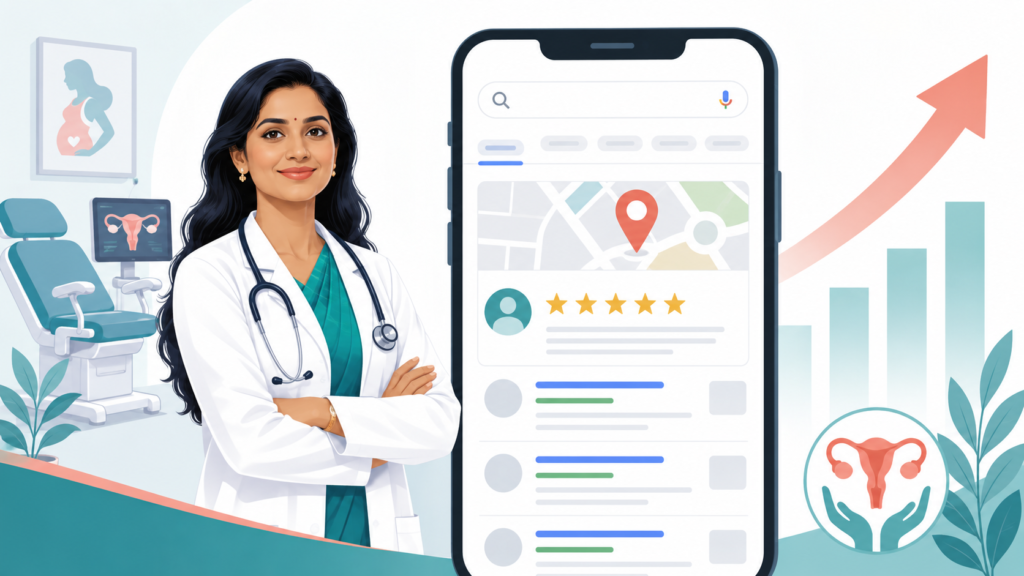
Here’s a small experiment. Open Google right now and search “best gynecologist near me.”
Whose clinic showed up first? If it wasn’t yours, this article was written for you.
Because here’s the uncomfortable truth about SEO for gynecologists in India: the doctors ranking at the top of Google aren’t always the most experienced ones in the city. They’re simply the ones whose online presence Google understands and trusts. Meanwhile, brilliant gynecologists with 15–20 years of practice remain invisible online — and invisible online increasingly means invisible, period.
We’ve worked with doctors across India long enough to notice a clear pattern: patient behaviour has changed faster than most clinics have. A woman looking for a gynecologist today doesn’t ask three neighbours and pick one. She searches on Google, reads reviews, checks your website (if you have one), compares two or three doctors, and then books an appointment. All of that happens before you’ve ever spoken to her.
If your practice doesn’t show up during that research phase, you’re not even in the running.
This guide breaks down exactly how gynecologists in India can use SEO (search engine optimization) to attract more patients — in plain language, with practical steps you can start applying this week.
Why SEO Matters More for Gynecologists Than Almost Any Other Specialty
Every doctor benefits from SEO. But gynecology has three characteristics that make it uniquely search-driven:
1. Patients search privately before they ask anyone. Gynecological concerns — irregular periods, PCOS, fertility issues, pregnancy questions, menopause symptoms — are deeply personal. Many women in India hesitate to discuss these openly, even with family. So where do they turn first? Google, quietly, often late at night on their phone. The doctor whose content answers those private questions earns trust before the first consultation.
2. It’s an intensely local decision. Nobody travels 400 km for a routine gynecologist visit. Searches in this specialty are overwhelmingly local — “gynecologist in Andheri,” “lady gynecologist near me,” “best maternity doctor in Salt Lake.” This is actually great news, because local SEO is far easier to win than national SEO. You’re not competing with all of India. You’re competing with 10–15 clinics in your area, most of whom are doing very little online.
3. The lifetime value of one patient is enormous. A single patient who finds you for a PCOS consultation may stay with you through pregnancy, delivery, postnatal care, and eventually annual check-ups for a decade — and refer her sister, her friends, her colleagues. One good Google ranking doesn’t bring you one appointment. It compounds.
First, Understand How Patients Actually Search
Before touching any SEO tactic, it helps to think like your patient. Searches for a gynecologist generally fall into three buckets:
Symptom searches (early stage): “Why is my period late but not pregnant,” “PCOS symptoms in Hindi,” “white discharge causes.” The searcher isn’t looking for a doctor yet — she’s looking for answers. Blog content wins here.
Doctor-hunting searches (decision stage): “Best gynecologist in Durgapur,” “lady gynecologist near me open now,” “gynecologist for PCOS treatment [city].” This is high-intent traffic. Your Google Business Profile and service pages win here.
Verification searches (trust stage): “Dr. [Your Name] reviews,” “[Your clinic name] contact number.” She’s almost decided — she’s just double-checking. Your reviews, website, and consistent listings win here.
A complete SEO strategy covers all three stages. Most clinics that attempt SEO only optimize for the second bucket and wonder why growth is slow. Let’s fix that.
Step 1: Claim and Fully Optimize Your Google Business Profile
If you do only one thing from this entire article, do this. Your Google Business Profile (formerly Google My Business) is what appears in the “map pack” — those top three local results with the map, star ratings, and “Call” button. For local searches like “gynecologist near me,” the map pack gets more clicks than everything else on the page combined.
Here’s how to optimize it properly:
- Choose the right primary category. Select “Gynecologist” — not the generic “Doctor” or “Hospital.” Google’s category matching is literal, and this single setting heavily influences which searches you appear for.
- Fill every field. Services, appointment link, opening hours (including Sunday hours if you have them), photos of the clinic exterior and interior, your qualifications in the description. Profiles that are 100% complete rank noticeably better than half-filled ones.
- Add real photos, regularly. A clean waiting room, the consultation cabin, the signboard, your team. Patients — especially first-time patients visiting a gynecologist — feel reassured when they can “see” the clinic before arriving. Stock photos actively hurt trust.
- Keep NAP consistent. Your Name, Address, and Phone number must be identical everywhere online — Practo, Justdial, Lybrate, your website, Facebook. Even small mismatches (“Road” vs “Rd”) confuse Google and dilute your ranking.
- Post weekly updates. Google Business Profiles allow posts. A short health tip, a vaccination reminder, festival timings — anything. Active profiles signal to Google that the business is alive and engaged.
Step 2: Build Reviews Like a System, Not an Accident
Reviews are the single strongest local ranking factor after proximity — and for a gynecologist, they’re also the strongest conversion factor. A woman choosing between two doctors will almost always pick the one with 180 warm, detailed reviews over the one with 12.
The mistake most doctors make? Waiting for reviews to happen naturally. They won’t. Happy patients forget; unhappy ones remember. You need a system:
- Ask at the moment of gratitude. The best time is right after a positive outcome — a healthy delivery, a resolved concern, a successful procedure follow-up. A simple, warm request works: “If you found the care helpful, a Google review would mean a lot to us.”
- Make it one-tap easy. Create your direct review link (Google provides this in your Business Profile dashboard) and turn it into a QR code at the reception desk, or send it via WhatsApp after the visit.
- Reply to every single review. Thank positive reviewers by first name where appropriate. Respond to negative ones calmly and professionally — never confirm that the person was a patient or discuss their condition (that’s a privacy violation). A graceful reply to criticism often impresses future patients more than a 5-star review does.
One important note: never buy or fabricate reviews. Google’s detection has become aggressive, and a penalty on a medical profile is very hard to recover from. Slow and genuine beats fast and fake, every time.
Step 3: Get Your Website’s Foundations Right
Many gynecologists in India either have no website or have a five-page brochure site built in 2017 that hasn’t been touched since. Your website is your digital clinic — and Google evaluates it the way a patient evaluates your waiting room.
The non-negotiables:
- Mobile-first design. In India, 80%+ of your visitors will arrive on a phone. If they have to pinch and zoom to read your services, they’re gone in three seconds — and Google notices that exit.
- Speed. Compress images, avoid heavy sliders, use decent hosting. A page that takes more than 3–4 seconds to load on mobile data bleeds patients.
- HTTPS. The padlock in the browser. For a healthcare site, this is basic hygiene — Google flags non-secure sites, and patients rightly hesitate to share phone numbers on them.
- Click-to-call and WhatsApp buttons. Indian patients love WhatsApp. A floating WhatsApp button on your site can single-handedly increase enquiries by 30–40% in our experience with doctor websites.
- A dedicated page for each service. This one is huge and almost universally missed. Don’t cram “PCOS, pregnancy care, infertility, menopause, laparoscopy” into one Services page. Create a separate, detailed page for each — “PCOS Treatment in [Your City],” “High-Risk Pregnancy Care in [Your City],” and so on. Each page can then rank for its own set of searches. One page can’t rank for twenty conditions; twenty pages can.
On-page basics for every page:
- One clear H1 heading containing the main keyword (“PCOS Treatment in Kolkata — Dr. Sharma”)
- The keyword naturally in the first paragraph, the page title, and the URL
- Descriptive subheadings (H2s) that mirror the questions patients actually ask
- Your credentials, photo, and clinic address visible — Google’s health-content guidelines (E-E-A-T: Experience, Expertise, Authoritativeness, Trustworthiness) reward medical content clearly attributed to a real, qualified doctor
Step 4: Write Content That Answers What Women Are Quietly Searching

This is where gynecologists have an unfair advantage most other specialists don’t: your patients generate an enormous volume of private, question-based searches. Every one of those questions is a doorway to your clinic.
Think about the questions you answer in your consultation room every single day:
- “Is spotting normal in early pregnancy?”
- “What foods should I avoid with PCOS?”
- “When should I see a gynecologist for irregular periods?”
- “Is it safe to exercise during the third trimester?”
- “What is the right age for a first gynecologist visit?”
Each of these is searched thousands of times a month across India. Write a clear, honest, 800–1,200 word blog post answering each one — in the same warm, reassuring tone you’d use with a patient — and you begin building what SEO professionals call topical authority. Google starts recognizing your website as a genuine source on women’s health, which lifts the rankings of your entire site, including your appointment pages.
A few content rules that matter specifically for medical topics:
- Write it yourself, or review it thoroughly if someone drafts it for you. Google holds health content (it calls this “Your Money or Your Life” content) to a higher standard. Generic, copied, or factually loose medical articles can hurt your site rather than help it.
- Add your byline and credentials to every article. “Medically reviewed by Dr. [Name], MBBS, MS (OBG)” is a genuine ranking and trust signal.
- Answer the question directly in the first two paragraphs, then elaborate. This wins featured snippets and, increasingly, citations in AI-powered search results (ChatGPT, Google’s AI Overviews, Perplexity) — which is fast becoming the next frontier of patient discovery.
- Consider Hindi or regional-language content. Searches like “PCOS ka ilaj” have huge volume and almost no quality competition from doctors. If your patient base is Hindi or Bengali speaking, a bilingual blog is a genuine moat.
- End every post with a soft, local call-to-action. “If you’re experiencing these symptoms, you can consult us at [Clinic Name], [Area, City] — book an appointment here.”
One blog post a week is enough. In six months, that’s 25+ pages working for you around the clock, answering questions while you sleep — and gently guiding readers toward your appointment page.
Step 5: Local SEO Signals Beyond Google Maps
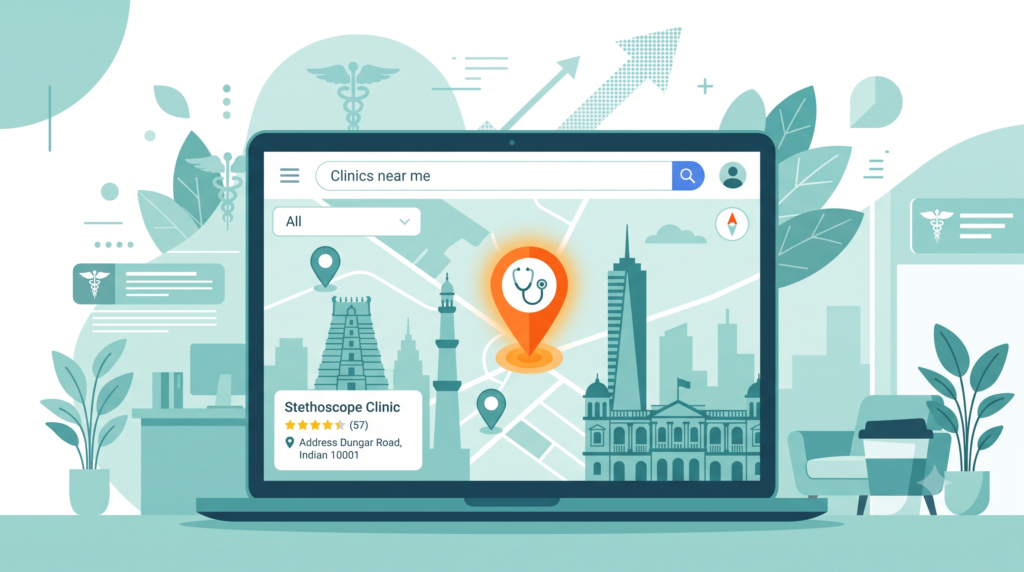
A few additional moves that strengthen your local presence:
Directory consistency. Make sure your practice is listed — with identical details — on Practo, Justdial, Lybrate, Sulekha, and any hospital or medical association directories relevant to you. These listings act as “citations” that reinforce your legitimacy to Google.
Location keywords on your website. Mention your area, nearby landmarks, and city naturally across your site. A line like “Our clinic is located in City Centre, Durgapur, a short walk from the bus stand” helps both patients and search engines place you.
Local schema markup. This is a small piece of code (your web developer can add it in an hour) that explicitly tells Google: this is a medical clinic, here’s the doctor, the specialty, the address, the hours, the reviews. Structured data like this makes you eligible for rich results — star ratings appearing directly in search listings, for instance — which dramatically improves click-through rates.
Earn local mentions. A health column in a local news portal, a talk at a school or corporate wellness event that gets covered online, a mention on your hospital’s website — each of these creates a backlink (another site linking to yours), which remains one of Google’s strongest trust signals.
What NOT to Do: Mistakes That Quietly Sink Doctor Websites
We’ve audited enough gynecologist websites to know the recurring self-inflicted wounds:
- Copy-pasting content from other medical sites or from health portals. Google identifies duplicate content instantly, and it will simply refuse to rank it. Every word on your site should be original.
- Keyword stuffing. Repeating “best gynecologist in [city]” fourteen times on one page reads as spam to both Google and human beings. Write naturally; mention the keyword where it genuinely fits.
- Ignoring the website after launch. SEO is not a one-time setup. A site untouched for two years sends a staleness signal. Even monthly updates keep it breathing.
- Fake or incentivized reviews. Already covered, but worth repeating — the risk-to-reward ratio is terrible.
- Expecting results in two weeks. SEO for a gynecologist typically shows meaningful movement in 3–4 months and strong, compounding results in 6–12. Anyone promising “#1 on Google in 30 days” is either lying or using tactics that will get you penalized. Patience here is not a weakness; it’s the strategy.
A Realistic 90-Day Roadmap
If all of the above feels overwhelming, here’s how we’d sequence it:
Month 1 — Foundations. Claim and fully optimize your Google Business Profile. Fix NAP consistency across all directories. Ensure your website is mobile-friendly, fast, and secure. Set up your review-collection system with a QR code and WhatsApp link.
Month 2 — Structure. Build individual service pages for your top 5–6 services, each optimized for its own local keyword. Add schema markup, click-to-call, and WhatsApp buttons. Publish your first 4 blog posts answering common patient questions.
Month 3 — Momentum. Continue weekly blogging. Push actively for reviews after every positive patient interaction. Start pursuing 2–3 local mentions or backlinks. Review your Google Business Profile insights and Search Console data to see which searches are already bringing you visibility — then double down on those.
By day 90, you won’t be at the top of Google for everything — but you’ll be visible, growing, and ahead of the majority of gynecologists in your city who still haven’t started.
Frequently Asked Questions
How much does SEO cost for a gynecologist in India?
It varies widely — from ₹10,000–15,000/month for basic local SEO to ₹40,000+ for aggressive, content-heavy campaigns in competitive metros. What matters more than price is whether the agency understands healthcare specifically; medical SEO has rules (content standards, privacy, advertising ethics) that generalist agencies routinely violate.
Can I do SEO myself?
The foundations — Google Business Profile, reviews, basic content — absolutely yes, and this article gives you that playbook. The technical layer (site speed, schema, link building) usually benefits from professional help. Many doctors do a hybrid: they write or review the content, and a specialist handles the technical machinery.
How long before I see new patients from SEO?
Local map-pack improvements can appear within 4–8 weeks if your profile was previously neglected. Website rankings typically take 3–6 months. The trajectory is compounding — slow at first, then surprisingly fast.
Is SEO better than running Google Ads?
They serve different purposes. Ads bring patients tomorrow but stop the moment you stop paying. SEO takes months but builds an asset that keeps producing patients for years at effectively zero marginal cost. The strongest practices we work with run both: ads for immediate flow, SEO for the long game.
Does SEO work in smaller cities and tier-2/tier-3 towns?
Honestly, it works better there. Competition is thinner, and a well-optimized clinic in a tier-2 city can dominate local search within months — something that takes years in South Delhi or Bandra.
The Bottom Line
Your next hundred patients are already searching. The only question is whether they find you or the clinic two lanes away.
SEO for gynecologists in India isn’t about tricking an algorithm — it’s about making your genuine expertise visible to the women who are quietly, privately looking for exactly the care you provide. Start with your Google Business Profile this week. Build reviews into your routine. Publish answers to the questions you hear every day in your consultation room. Six months from now, your calendar will tell you it was worth it.
And if you’d rather focus on medicine while specialists handle the digital side — that’s precisely what we do at Doctors Branding. We help gynecologists and doctors across India build online visibility that converts into real appointments. Get in touch for a free audit of your current online presence.