
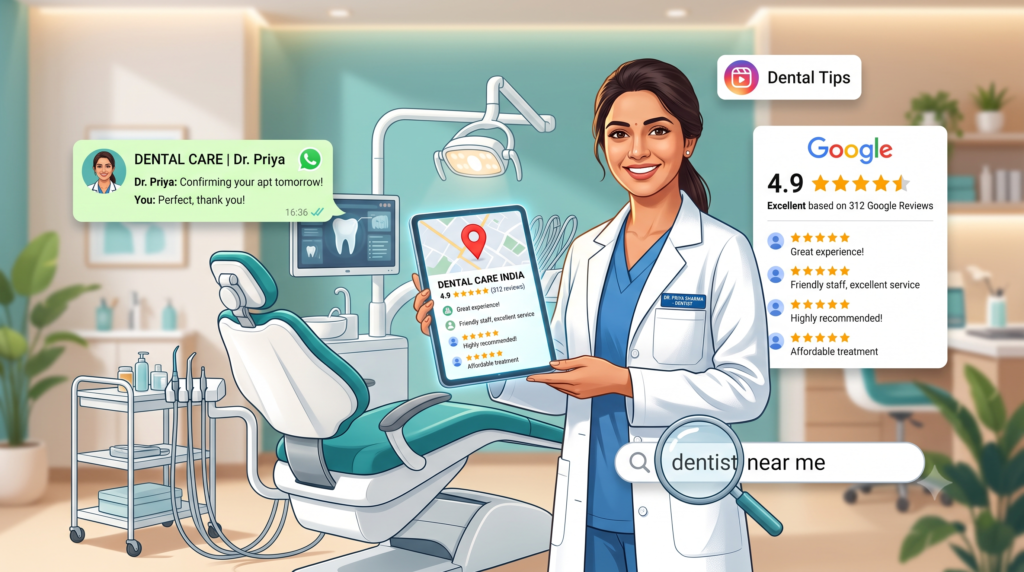
Walk into any dental clinic in Chennai, Pune, or Indore and ask the dentist where their new patients come from. Ten years ago, the answer was almost always “word of mouth.” Today? The honest answer is Google — even when the dentist doesn’t realize it. That “referral” from a neighbour usually involved the patient typing your clinic’s name into a search bar first, checking your reviews, glancing at your photos, and only then booking an appointment.
That’s exactly why digital marketing for dentists in India is no longer optional. It’s the front door of your practice. And in 2026, that front door is more crowded than ever — India now has over 2.7 lakh registered dentists, and in metro cities you’ll find four to six clinics within a single kilometre. The clinics that show up online win. The ones that don’t stay dependent on footfall and luck.
Having worked with dental practices across tier-1 and tier-2 cities, I’ve seen the same pattern repeat: the clinics growing fastest aren’t necessarily the ones with the best equipment or the most experienced hands. They’re the ones patients can find. This guide breaks down everything that actually moves the needle for Indian dental clinics in 2026 — no fluff, no recycled Western advice that ignores how Indian patients actually search and book.
Why Dental Clinics in India Can’t Ignore Digital Marketing in 2026
Let’s start with what’s changed in patient behaviour, because your marketing should follow your patient — not the other way around.
Patients research before they trust. A toothache at 11 pm doesn’t lead to a phone call anymore. It leads to a search: “dentist near me open now” or “root canal cost in Coimbatore.” If your clinic doesn’t appear in those moments, you simply don’t exist for that patient.
Reviews have replaced referrals. Indian patients treat Google reviews the way they once treated a recommendation from a family friend. A clinic with 250 reviews at 4.8 stars will consistently out-book a clinic with 12 reviews at 5 stars — volume signals trust.
Voice and vernacular search are mainstream. A growing share of dental searches in India now happen in Hindi, Tamil, Telugu, Marathi, and other regional languages — often spoken, not typed. “पास में अच्छा डेंटिस्ट” is a real query your clinic can rank for, and most of your competitors haven’t even thought about it.
Insurance and EMI awareness is rising. Patients increasingly search for treatment costs, EMI options for implants and aligners, and cashless insurance tie-ups. Clinics that answer these questions online capture high-value patients before competitors ever get a chance.
AI search is changing discovery. Patients now ask ChatGPT, Google’s AI Overviews, and Perplexity questions like “best invisible aligner clinic in Hyderabad.” If your clinic’s information isn’t structured, cited, and consistent across the web, AI tools won’t mention you. This is the newest battleground, and in 2026 it’s still wide open.
The Foundation: Get Your Google Business Profile Right First
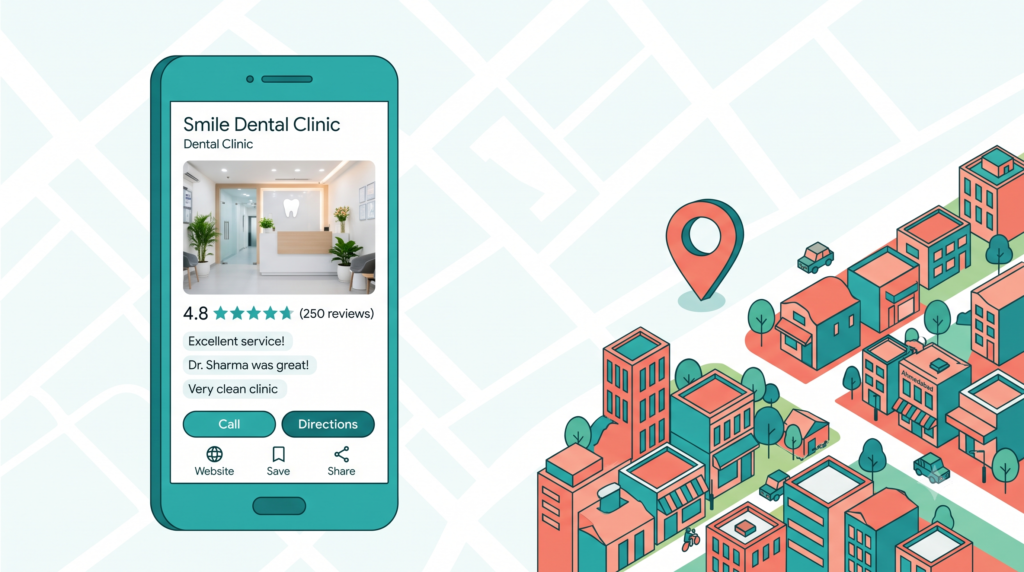
If you do only one thing after reading this guide, do this. Your Google Business Profile (GBP, formerly Google My Business) drives more patient calls for a local dental clinic than any other single channel — often more than your website itself.
Here’s what a fully optimised dental GBP looks like in 2026:
Complete every field. Clinic name (exactly as it appears on your signage — no keyword stuffing like “Best Dentist Delhi Dr. Sharma”), accurate categories (primary: Dentist; secondary: Dental implants provider, Orthodontist, Pediatric dentist — whichever apply), working hours including lunch breaks, and a local phone number that someone actually answers.
Upload real photos monthly. Clinic exterior (so patients can find you), reception, treatment rooms, sterilisation area, and your team. Indian patients are quietly evaluating hygiene from your photos. Stock images are a trust killer — patients can spot them instantly.
Use Google Posts weekly. Share treatment education, festive-season offers (Diwali smile makeover packages perform remarkably well), and new equipment announcements. Active profiles rank higher in the local map pack.
Add services with descriptions and price ranges. “Root canal treatment — ₹4,000 to ₹8,000 depending on tooth” filters out price-shoppers and pre-qualifies serious patients.
Answer the Q&A section yourself. Seed it with the questions patients ask on the phone every day: Do you accept insurance? Is parking available? Do you treat children? If you don’t answer these, random users will — sometimes incorrectly.
The Review Engine Every Clinic Needs
Reviews deserve their own system, not an afterthought. The clinics I’ve seen dominate their local map pack all run some version of this loop:
- Ask at the moment of delight — right after a painless extraction or when the patient sees their new smile in the mirror. Not three days later by SMS.
- Make it a two-tap process. A QR code at the reception desk linking directly to your review form. WhatsApp the link before the patient leaves the chair.
- Reply to every single review within 48 hours — including the bad ones. A calm, professional response to a 1-star review (“We’re sorry about the wait time on Saturday — we’ve since added a second evening slot…”) often does more for your reputation than ten 5-star reviews. Never confirm the person was your patient or discuss their treatment; that violates patient confidentiality.
- Target keywords in your replies naturally. “Thank you for trusting us with your dental implant treatment in Vashi” reinforces local relevance without being spammy.
A realistic target: 8–15 new reviews per month. Within six months, that compounding volume typically pushes clinics into the local 3-pack for their main treatment keywords.
Your Website: The 24/7 Receptionist That Never Takes Leave
Many Indian dental clinics still treat their website as a digital business card — a homepage, an “About Doctor” page, and a contact form nobody checks. In 2026, that’s leaving serious money on the table.
Here’s what a patient-converting dental website needs:
One page per treatment, not one page for all treatments. A single “Our Services” page listing 15 treatments can’t rank for anything. Separate, detailed pages for root canal treatment, dental implants, invisible aligners, teeth whitening, pediatric dentistry, and full mouth rehabilitation give Google 6+ chances to rank you — and give patients the depth they’re looking for.
Local landing pages if you serve multiple areas. A clinic in Andheri West should have content that mentions Andheri, Juhu, and Versova naturally — because that’s how patients search.
Cost transparency (ranges, not exact figures). “How much does a dental implant cost in India?” is one of the highest-volume dental searches in the country. Pages that answer it honestly — with ranges, factors affecting price, and EMI options — attract exactly the patients ready to book consultations.
WhatsApp booking, front and centre. In India, a WhatsApp button converts 3–4x better than a contact form. Patients want to send a photo of their problem tooth and ask “how much?” Let them.
Speed and mobile-first design. Over 80% of your traffic will come from mobile phones, many on mid-range devices and patchy 4G. If your site takes more than three seconds to load, half your visitors are gone. Compress every image, skip the heavy sliders, and test your site on an actual budget Android phone — not just your iPhone.
Trust signals everywhere. Doctor qualifications (BDS/MDS clearly stated), clinic registration details, real patient photos (with written consent), before-after galleries where regulations permit, and association memberships. Indian patients are sceptical by default; your website’s job is to lower that scepticism before the first call.
SEO for Dentists: Ranking When Patients Search
Search engine optimisation is the long game — and the highest-ROI channel for dental clinics once it kicks in. Unlike ads, rankings don’t stop the moment you stop paying.
Local SEO: Win the Map Pack
For a dental clinic, local SEO matters far more than national rankings. Nobody travels 400 km for a filling. Your local SEO checklist for 2026:
- NAP consistency: Your clinic’s Name, Address, and Phone number must be identical everywhere — Google, Justdial, Practo, Sulekha, Lybrate, your website footer, Facebook page. Even “Road” vs “Rd” inconsistencies dilute your local authority.
- Local citations: Get listed on India-specific directories — Practo and Justdial carry real weight, but so do city-specific listings and dental association directories.
- Location keywords in title tags: “Dental Implants in Ahmedabad | [Clinic Name]” — not just “Dental Implants.”
- Embedded Google Map on your contact page, and locality names woven naturally into your content.
Content SEO: Answer What Patients Actually Ask
The most underused growth lever in Indian dental marketing is a simple blog that answers real patient questions. Not “The History of Dentistry” — nobody searches that. Instead:
- “Root canal vs extraction: which is better?”
- “Invisible aligners cost in India: complete price breakdown”
- “Is teeth whitening safe? A dentist explains”
- “Wisdom tooth pain: home remedies vs when to see a dentist”
- “Dental implant vs bridge: honest comparison for Indian patients”
Two well-researched articles per month, written in simple language (your patients aren’t dentists — write for a worried 34-year-old, not a journal reviewer), consistently outperform sporadic bursts of ten articles followed by six months of silence.
Pro tip for 2026: Add an FAQ section to every treatment page and blog post, marked up with FAQ schema. This dramatically increases your chances of appearing in Google’s AI Overviews and being cited by ChatGPT and Perplexity when patients ask AI tools for advice. Structured, direct answers are what AI systems pull from.
Technical Basics You Can’t Skip
You don’t need to become a developer, but insist that whoever manages your site handles these: HTTPS everywhere, an XML sitemap submitted in Google Search Console, LocalBusiness + Dentist schema markup, image compression, and Core Web Vitals in the green. Check Search Console once a month — it’s free and tells you exactly what patients searched to find you.
Google Ads for Dentists: Fast Patients, If You Do It Right
SEO takes 4–8 months. Google Ads brings patients this week — which is why it’s the right starting channel for new clinics. But it’s also where I’ve seen clinics burn ₹50,000 a month with nothing to show for it. The difference is almost always in the setup.
What works for Indian dental clinics in 2026:
- Bid on high-intent, treatment-specific keywords: “dental implant clinic in Jaipur,” “emergency dentist near me,” “invisalign treatment cost Bangalore.” Skip broad terms like “dentist” — they attract job-seekers, students, and price-window-shoppers.
- Use negative keywords aggressively. Block “salary,” “course,” “college,” “free,” “government” from day one. This alone saves 20–30% of wasted spend.
- Radius targeting of 3–7 km around your clinic for general dentistry; expand to city-wide only for high-ticket treatments like implants and full-mouth rehabilitation, where patients will travel.
- Send clicks to treatment-specific landing pages — never your homepage. A patient searching for aligners should land on your aligner page with cost info, before-after photos, and a WhatsApp button. This one change routinely doubles conversion rates.
- Call-only ads for emergencies. “Severe tooth pain” searches at 9 pm should trigger an ad whose only action is calling your clinic.
- Track calls and WhatsApp clicks as conversions. If you’re not measuring which keywords produce actual appointments, you’re not running ads — you’re donating to Google.
Realistic budgets: In tier-2 cities, meaningful results start around ₹15,000–₹25,000/month in ad spend. In metros, competitive treatments like implants and aligners typically need ₹30,000–₹60,000/month. Cost per lead for high-value treatments ranges from ₹300–₹900 depending on city and competition — which is excellent economics when a single implant case is worth ₹25,000–₹45,000.
Social Media Marketing for Dental Clinics: Build Trust Before the First Visit
Here’s the mindset shift: social media rarely produces same-day appointments. What it does — brilliantly — is make patients feel like they already know you before they walk in. That familiarity shortens the trust-building that Indian patients need before letting anyone near their teeth.
Instagram: Your Clinic’s Visual Trust File
Instagram is the primary social channel for dental clinics in 2026, especially for cosmetic treatments. What performs:
- Reels of transformations (with patient consent, always) — smile makeovers, aligner journeys, whitening results
- “Day in the clinic” content — your team, your sterilisation process, your technology. Demystifying the clinic reduces dental anxiety, which is a real booking barrier in India.
- Myth-busting in regional languages — “Does scaling weaken teeth?” answered in Hindi or Tamil consistently outperforms English-only content outside metros
- Doctor-on-camera explainers — 30–60 seconds, one question, simple answer. Patients book people, not clinics.
Posting rhythm that’s sustainable: 3–4 Reels per week plus daily Stories. Consistency beats production quality — a dentist explaining wisdom teeth on a phone camera outperforms a polished agency video with no human face.
Facebook: Still Alive for the 35+ Audience
Don’t write off Facebook. For family dentistry, pediatric services, and the 35+ demographic (your implant and full-mouth-rehab patients), Facebook remains effective — especially local community groups where “can anyone suggest a good dentist in [area]?” gets asked weekly. Being active and helpful in those groups is free marketing.
YouTube: The Long-Term Authority Play
Longer explainers — “Complete guide to root canal treatment,” “Dental implant procedure step by step” — rank in both YouTube and Google search for years. One good video per month is enough. Bonus: YouTube content in Hindi and regional languages has far less competition than English.
WhatsApp: India’s Most Underrated Dental Marketing Channel
WhatsApp Business is where Indian healthcare marketing actually converts. Set up:
- Quick replies for common questions (timings, location, cost ranges)
- Catalog listing treatments with price ranges
- Appointment reminders (no-shows drop by 30–40% with a simple day-before message)
- Post-treatment follow-ups — a “How are you feeling today?” message the day after an extraction generates goodwill that turns into reviews and referrals
- Broadcast lists for genuinely useful content only — dental care tips, festive offers. Spam gets you blocked and reported.
Online Reputation: Practo, Justdial & the Directories Patients Actually Check
Love them or not, Practo and Justdial appear on page one for almost every “dentist in [city]” search in India. You can’t ignore platforms that rank above your own website.
The smart approach: maintain complete, accurate profiles with photos and updated timings, gather reviews there too (not just Google), and treat them as top-of-funnel discovery — while making sure your own website and WhatsApp are where the relationship actually happens. Don’t build your entire practice on rented land; commission structures and algorithm changes on these platforms are outside your control.
What About AI Search? Preparing for How Patients Find Dentists in 2026
This is the section most guides skip, and it’s where early movers win. Patients increasingly ask AI assistants — ChatGPT, Google’s AI Overviews, Perplexity — questions like “best dental implant clinic in Kochi” or “how much do aligners cost in India?”
AI tools cite clinics that have:
- Consistent, structured information across the web (schema markup, identical NAP, clear service descriptions)
- Direct, factual answers on their pages — FAQ formats, cost tables, procedure steps
- Third-party validation — reviews, press mentions, directory presence, backlinks from health publications
- Fresh content — pages updated within the last year get preferred
The practical move: audit your top five treatment pages this quarter. Add an FAQ block, a cost table, and a “last updated” date to each. It takes an afternoon per page and positions you for a discovery channel most competitors haven’t noticed yet.
A Realistic Monthly Budget for Indian Dental Clinics

One of the most common questions I hear: “How much should I actually spend?” Here’s a grounded framework for 2026:
| Practice Stage | Monthly Budget | Where It Goes |
|---|---|---|
| New clinic (0–2 yrs) | ₹25,000–₹40,000 | Google Ads (60%), GBP + reviews (20%), basic content (20%) |
| Growing clinic | ₹40,000–₹80,000 | Ads (40%), SEO + content (30%), social media (20%), tools (10%) |
| Established / multi-chair | ₹80,000–₹1,50,000+ | SEO (30%), ads for high-ticket treatments (30%), video + social (25%), reputation & CRO (15%) |
A useful sanity check: if your average patient value is ₹8,000–₹10,000 (blended across cleanings and high-ticket cases) and your marketing brings 25–40 new patients monthly, even the higher budgets pay for themselves several times over. Track cost per acquired patient, not vanity metrics like impressions and likes.
The Compliance Line: What Dentists in India Must Not Do
Digital marketing for healthcare in India operates within ethical boundaries set by the Dental Council of India and advertising standards. Stay on the right side:
- No “best dentist” or “No. 1 clinic” claims — superlatives invite regulatory trouble and erode trust anyway
- No guaranteed results (“100% painless,” “permanent whitening”)
- Patient photos and testimonials only with explicit written consent
- No misleading discounts designed to bait-and-switch
- Educate, don’t solicit. The safest and most effective positioning is the dentist-as-educator — which, conveniently, is also what Google and patients reward.
Your First 90 Days: A Practical Action Plan
Overwhelmed? Don’t be. Here’s the order of operations that works:
Month 1 — Foundation. Claim and fully optimise your Google Business Profile. Set up WhatsApp Business properly. Start the review engine (QR code at reception, ask every happy patient). Fix your website’s mobile speed and add WhatsApp buttons.
Month 2 — Visibility. Launch a tightly-targeted Google Ads campaign for your two most profitable treatments. Publish your first two treatment-focused blog posts with FAQ schema. Begin posting 3 Reels a week.
Month 3 — Momentum. Build local citations (Practo, Justdial, local directories). Publish two more content pieces. Review your ads data ruthlessly — kill what’s not converting, double down on what is. Record your first YouTube explainer.
By day 90, you should see: 20–40 new Google reviews, measurable ad-driven appointments, early ranking movement on local keywords, and — most importantly — a repeatable system rather than random acts of marketing.
Frequently Asked Questions
How much does digital marketing cost for a dental clinic in India?
Most clinics see meaningful results with ₹25,000–₹60,000 per month, covering ads, SEO, and content. Solo practitioners can start smaller (₹15,000–₹20,000) by focusing purely on Google Business Profile optimisation and a modest ads budget.
How long before SEO shows results for a dental clinic?
Local map-pack improvements often appear within 2–3 months if you’re active with reviews and GBP posts. Organic website rankings for treatment keywords typically take 4–8 months. Google Ads fills the gap in the meantime.
Which is better for dentists: Google Ads or Instagram ads?
Google Ads captures patients actively searching for treatment (high intent, faster conversions). Instagram builds awareness and trust for cosmetic treatments (aligners, smile makeovers). Most growing clinics need both, weighted toward Google Ads early on.
Can I do dental marketing myself or should I hire an agency?
You can absolutely handle GBP, reviews, and WhatsApp yourself — and you should, at least initially, because nobody knows your patients better. Ads, SEO, and website work usually justify professional help once you’re spending more than ₹20,000/month, because mistakes at that level cost more than fees.
Is it legal for dentists to advertise in India?
Yes — educational and informational marketing is permitted. What’s restricted is misleading claims, guaranteed outcomes, and superlative titles like “best dentist.” Ethical, education-first marketing is both compliant and more effective.
Final Word: The Clinics That Win in 2026
The uncomfortable truth about digital marketing for dentists in India is that your clinical skill, on its own, no longer determines how full your appointment book is. Patients can’t evaluate your crown margins — but they can evaluate your reviews, your photos, your content, and how quickly you reply on WhatsApp.
The good news: most of your competitors are still doing this badly. Half-filled Google profiles, dead Instagram pages, websites last updated in 2021. The bar in Indian dental marketing is genuinely low, which means a clinic that executes even 70% of this guide consistently for six months will pull decisively ahead in its locality.
Start with your Google Business Profile this week. Build the review habit. Then layer in ads, content, and social — in that order. Your future patients are already searching. Make sure they find you.
Need help putting this into practice? The team at Doctors Branding specialises in digital marketing for dentists and healthcare practices across India — from local SEO and Google Ads to complete practice branding. Get in touch for a free clinic marketing audit.
